BIAB vs Gel vs Acrylic: Which Manicure Is Right for Your Nails?
Every nail salon menu comes with a small moment of panic built in. You sit down, the technician asks what you’re having, and three words that sound almost interchangeable (BIAB, gel, acrylic) suddenly feel like an exam you didn’t revise for. Pick the wrong one and you could leave with talons when you wanted tidy, or with a polish that chips before payday when you wanted something that lasts.
Here’s the thing: these aren’t three versions of the same treatment. They’re different systems built for different jobs. Once you know what each one is actually for, the decision gets much simpler, so here’s how they compare and which one deserves your next appointment.
BIAB vs Gel vs Acrylic: What’s the Difference?
The short answer: gel polish is colour, BIAB is reinforcement, and acrylic is construction.
Gel polish (the “gel manicure” on most menus, sometimes called Shellac after CND’s well-known brand) is a thin, flexible soft gel painted on like varnish and cured under a UV or LED lamp. It gives you shine and staying power, but very little extra strength.
BIAB stands for Builder In A Bottle, a soak-off builder gel made by The GelBottle. We’ve explained what BIAB nails are in detail elsewhere; for this comparison, all you need to know is that it’s thicker than gel polish and is used to create a slightly stronger, still-flexible overlay on your own nail. One useful detail: BIAB is technically a brand name, and many salons now use it as shorthand for any soak-off builder gel. It’s perfectly reasonable to ask which product you’re actually getting.
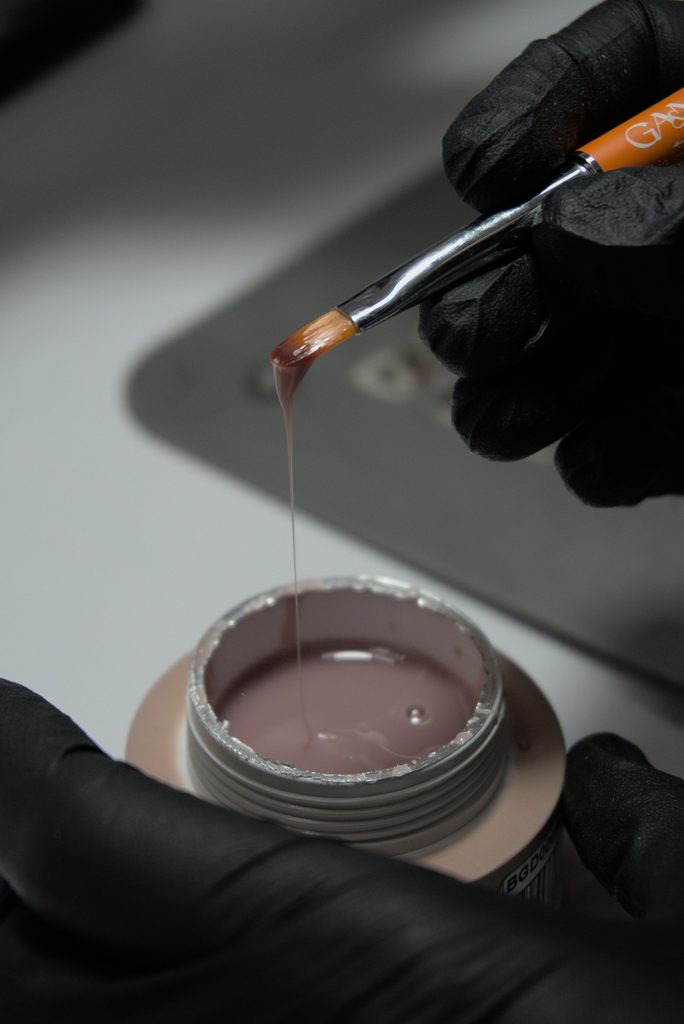
Acrylic is a different chemistry altogether. A liquid monomer and a powder polymer are mixed into a bead that the technician sculpts onto the nail, where it hardens in the air without a lamp. It’s rigid, very strong and the classic route to length.
Then there’s hard gel, the one that causes most of the confusion. It’s a sculpting gel that, unlike gel polish or BIAB, doesn’t soak off and has to be filed away. In terms of what it can do, it sits much closer to acrylic, which is why “gel nails” can mean two very different appointments.
| Gel polish | BIAB / soak-off builder gel | Hard gel | Acrylic | |
|---|---|---|---|---|
| Best for | Long-lasting colour on nails already in good shape | Natural-looking strength on short-to-medium natural nails | Sculpted extensions or a tough overlay | Length, dramatic shapes and statement nail art |
| Strength and flexibility | Thin and flexible; adds little strength | Stronger than gel polish, still flexible | Strong and fairly rigid | Very strong and the most rigid |
| Adds length? | No | A little, on your own nail; not designed for long extensions | Yes, with tips or forms | Yes, with tips or forms |
| Typical wear | Around two weeks | Usually three to four weeks before an infill | A few weeks before an infill, depending on growth | Usually two to three weeks before an infill |
| Maintenance | Removed and reapplied each time | Infills, so it can be worn continuously | Infills | Infills |
| Removal | Top coat buffed, then soaked in acetone | Bulk filed down, then soaked in acetone | Filed off; it doesn’t soak off | Bulk filed down, then soaked in acetone |
Wear times are a guide, not a promise. How fast your nails grow, how you use your hands and the skill of your technician all make a bigger difference than the label on the bottle.
BIAB vs Gel Nails: Which Is Better?
If your nails are already strong and you mainly want colour, choose gel polish. If they bend, peel or snap before they reach the length you’d like, choose BIAB.
The difference comes down to thickness and purpose. Gel polish simply rides along with your nail: if the nail flexes, the polish flexes with it, and if it’s flexing a lot, that’s usually when you see cracks along the tip. BIAB is applied in a thicker layer and shaped to give the nail a little structure, so it resists that bending far better.
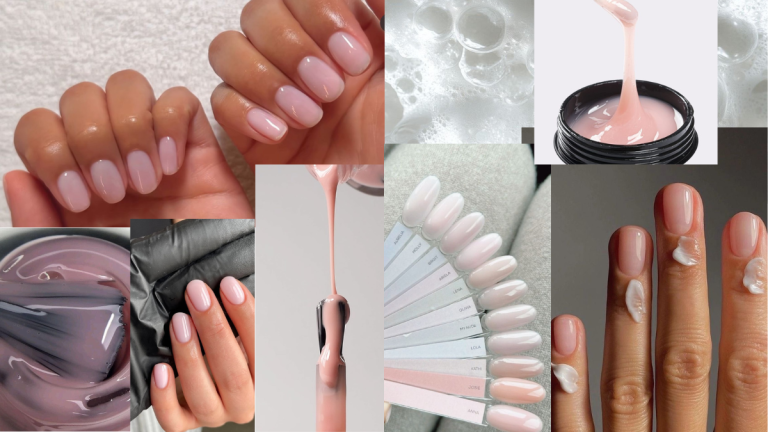
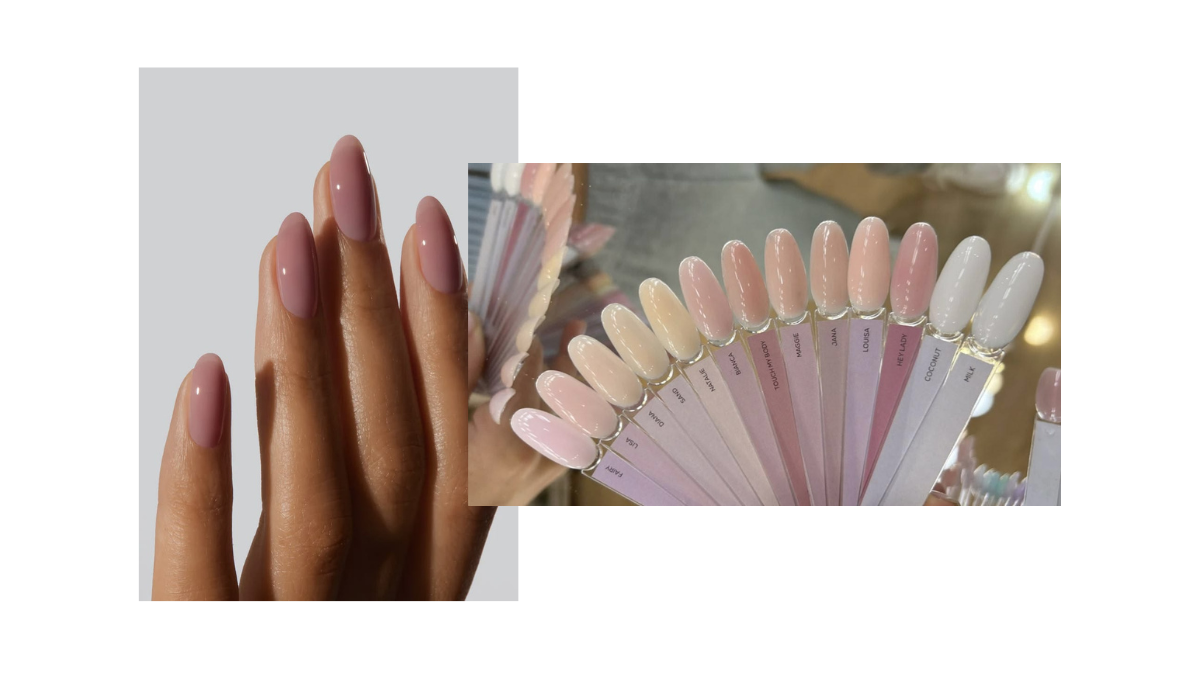
For a natural-looking finish, both can do the job, but in different ways. Gel polish in a sheer shade looks like a very good coat of varnish. BIAB in a milky pink or nude reads more like your own nails on an excellent day, partly because it smooths ridges and evens out the shape.
For weak or bendy nails, BIAB usually has the edge, simply because it adds support that gel polish can’t. One caveat: if your nails are weak because of previous enhancements or rough removals, no overlay will fix the underlying problem. It will only cover it up.
For a low-maintenance manicure, BIAB wins again. Gel polish is removed and redone every visit, whereas BIAB is typically infilled, with the grown-out area rebalanced rather than starting from scratch.
If you change colour constantly, though, gel polish is the more natural fit. Every removal is a clean slate. You can wear colour over a BIAB base and switch it at each infill, but if you want something new every ten days, BIAB’s whole infill rhythm starts working against you.
BIAB vs Acrylic Nails: Which Should You Choose?
Choose BIAB if you want to strengthen your own nails at a natural length. Choose acrylic if you want length or a shape your nails don’t have.
BIAB is an overlay: it sits on your natural nail and follows its shape. Acrylic is usually an extension, sculpted onto a form or applied over a tip to create a nail that’s longer and more architectural than the one underneath.
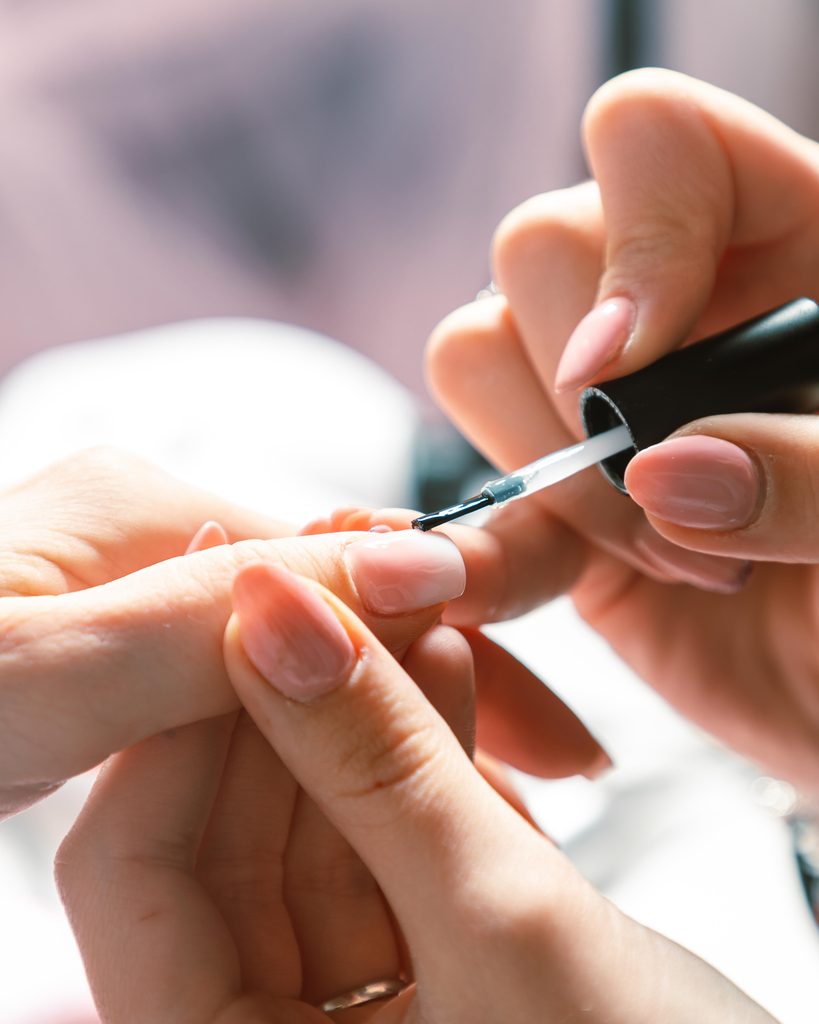
That’s also why their strengths differ. Long nails take a lot of leverage at the tip, and acrylic’s rigidity is exactly what stops a long coffin or stiletto shape from bending or snapping. BIAB’s flexibility, meanwhile, is its selling point on shorter nails: it moves a little with your nail rather than fighting it, which tends to feel more comfortable on thinner nail plates. Stretch a flexible builder gel into a dramatic extension and that flexibility becomes a weakness.
Both need infills, and acrylic generally asks for yours slightly more often. In skilled hands acrylic can be surprisingly slim, but because it’s built to support length it’s usually a little thicker, while BIAB generally looks closer to a bare nail. And if you’ve ever walked into a salon and noticed that distinctive smell, that’s the acrylic liquid.
So why would anyone choose acrylic over BIAB? Because some looks simply aren’t possible otherwise. If you want long, sharply shaped nails for a holiday, a wedding or just because you like them, acrylic (or hard gel) is the right tool. BIAB isn’t a gentler version of acrylic; it’s designed for a different result.
Gel vs Acrylic Nails: What’s the Difference?
This is where the wording trips people up, because “gel nails” can mean two quite different things.
Gel polish vs acrylic isn’t really a fair fight. Gel polish is a finish; acrylic is an enhancement. They aren’t competing for the same job, and plenty of people wear gel polish on top of acrylic for colour that lasts as long as the set.
Gel extensions vs acrylic is the real comparison. Both add length, but they’re made and removed differently:
- Curing: gel extensions cure under a UV or LED lamp; acrylic hardens in the air as the liquid and powder react.
- Feel and finish: gel tends to be a little more flexible and naturally glossy, with less odour during application. Acrylic is harder and very durable.
- Removal: hard gel has to be filed off. Some extension systems use soft-gel tips, which are designed to soak off in acetone. Acrylic soaks off too, though it takes a while.
Neither is automatically better. If you want hard-wearing length, acrylic and hard gel are both strong options, so the deciding factors are often how they feel on your nails and what your technician does best. If you want length for a few weeks and a simpler soak-off removal, ask about soft-gel tip extensions.
Which Manicure Is Least Damaging to Your Natural Nails?
No nail enhancement is damage-free, and anyone who tells you otherwise is selling something. BIAB isn’t automatically the healthy option, and acrylic doesn’t automatically ruin nails. Far more depends on how the treatment is applied, maintained and removed.
Preparation and removal are where most damage happens. Over-filing the nail during prep thins it out. So does picking off lifting product or prying off a set that hasn’t been properly softened. The British Association of Dermatologists has noted that acrylate-based nails can damage nails and cuticles during removal, whether by buffing, scraping or acetone soaking. Acetone itself is drying, and dermatologists have warned that very weak or brittle nails may not cope well with repeated soak-offs.
Whichever you choose, removal deserves as much care as application. A good technician will file down the bulk and soak off what’s left, never prise it off. If you’d rather tackle BIAB yourself, our guide to how to remove BIAB nails is worth reading before you reach for the acetone.
Allergies are the bigger, less-discussed issue. Gel polish, builder gels and acrylics all contain (meth)acrylate chemicals, and UK and Irish dermatologists have warned about rising rates of contact allergy linked to them. The risk is higher when uncured product touches the skin, when gel is cured under the wrong lamp, and with DIY kits. Once you’re sensitised, the allergy can affect more than your manicure: it may limit some dental and medical treatments later in life. If you notice itching, redness, swelling or nails lifting from the nail bed after an appointment, stop having the treatment and speak to your GP or a dermatologist.
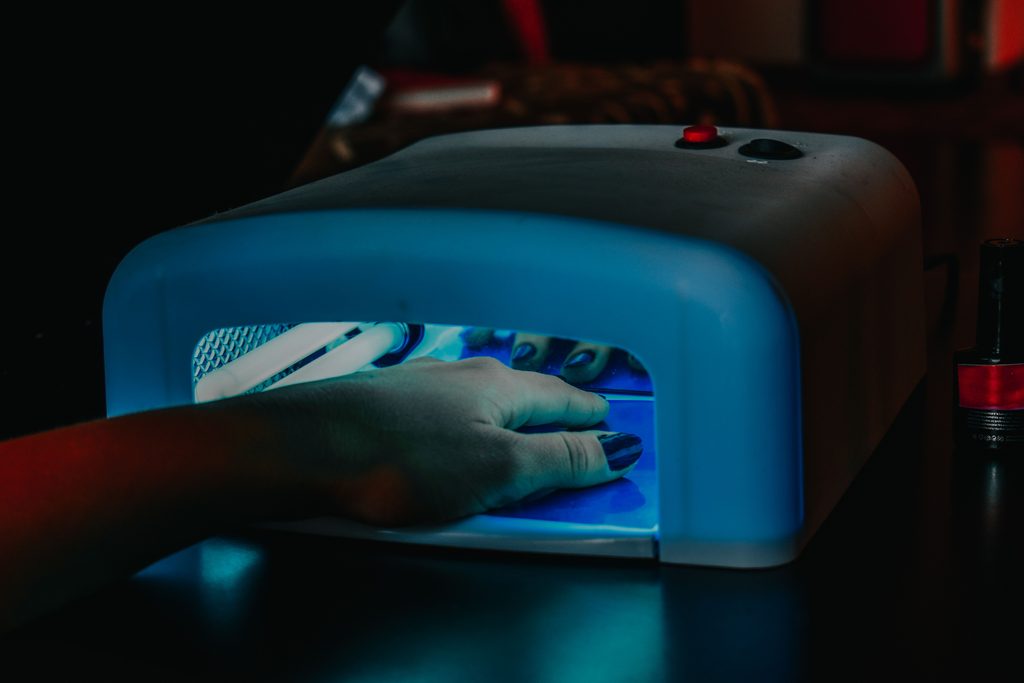
UV lamps are worth a mention, too. A 2023 laboratory study found that UV nail dryers damaged DNA in human and mouse cells, although it wasn’t carried out on people and couldn’t quantify a real-world risk. Dermatologists commonly suggest applying broad-spectrum sunscreen to your hands or wearing fingerless UV gloves during gel and BIAB appointments.
Which Manicure Is Right for You?
You want to grow your natural nails
Go for BIAB. Nails grow at their own pace, but a flexible overlay helps stop them snapping before they get anywhere. The trade-off is commitment: it works best with regular infills, and you’ll need a proper removal when you decide to stop.
You want long extensions
Book acrylic or hard gel. Both are built for length and hold dramatic shapes well. Expect infills every few weeks, and be aware that a hard knock to a long, rigid nail can damage the natural nail underneath. For a shorter-term option with soak-off removal, ask about soft-gel tips.
You love changing your nail colour
Stick with gel polish. It’s quick to swap, there’s no infill cycle to work around, and each appointment starts fresh. If your nails need support as well, BIAB with gel colour on top is a reasonable middle ground, provided you’re happy changing colour roughly once a month.
You prefer a natural-looking manicure
BIAB in a sheer nude, milky white or soft pink is the strongest choice for that “my nails, but better” look. If your nails are already strong and even, a sheer gel polish will get you most of the way there with less product.
You have weak or brittle nails
It depends on why they’re weak. Thin, bendy nails often do well with a carefully applied BIAB overlay. Nails that have become brittle after years of enhancements may need a break, regular polish and plenty of cuticle oil instead. If your nails change suddenly or don’t recover, it’s worth asking a GP or dermatologist rather than adding another layer.
You want fewer salon appointments
BIAB usually stretches furthest between visits. Just don’t push an infill too far: once product starts lifting, moisture and dirt can get trapped underneath and the nail is more likely to break.
You’ve reacted to nail products before
Skip all three for now. Gel polish, BIAB and acrylic all contain acrylates, so switching from one to another isn’t a solution. See a dermatologist, who may suggest patch testing, and stick with regular nail polish in the meantime.
Prices vary widely depending on where you live, the salon and the treatment itself. Extensions and nail art usually cost more than an overlay or a simple colour, so check the menu before you commit.
The Bottom Line
The best manicure isn’t the most talked-about one on the menu. It’s the one that matches what your nails actually need. Gel polish is a paint job, BIAB is reinforcement and acrylic is a renovation. Know which job you’re booking, choose a technician who’ll tell you exactly what they’re using and how it comes off, and any of the three can look brilliant.